


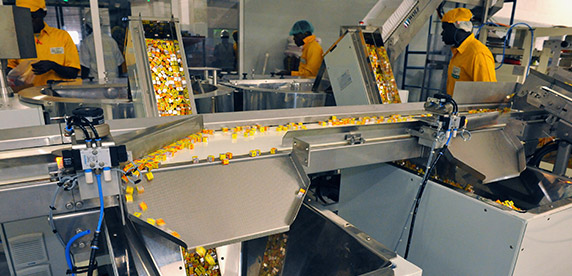
At Nestlé Nigeria’s Flowergate factory in Ogun State, the question is simple enough: can you produce more and still put less pressure on natural resources?
You can’t answer that with pledges. You have to look at what happens to water, to energy, to plastic and waste when production actually goes up. And you have to ask whether whatever is being done inside the factory is helping anyone outside it.
For manufacturers in Nigeria, this is no longer a side conversation. Plastic pollution is everywhere, waste collection is weak, pressure on water and other resources keeps rising. The numbers for how much plastic Nigeria generates differ depending on who you ask, but nobody disputes the scale. The Nigeria Climate Innovation Center has made the point that recycling can reduce pollution and at the same time create economic opportunity.
When your products are in almost every home, responsibility does not stop at the factory gate. It has to cover packaging design, how waste is recovered, how water is managed, how energy is used, and the farms that supply your raw materials.
Nestlé Nigeria says its sustainability agenda covers all those areas. The real question is whether it is turning into something you can measure and sustain.
Plastic pollution is one of the most visible environmental problems in Nigeria. It blocks drains, it is dumped indiscriminately, it ends up in waterways. Collecting it after people have used it is not enough. You have to design packaging better, build recovery systems that work, and make sure there is a real market for recycled material.
Nestlé Nigeria has reported some steps here. Its 2023 Annual Report says its Employee Plastics Collection Scheme was extended to Agbara, Flowergate and Abaji, with partnerships to trace and recycle what is collected. The report puts the collection from that scheme in 2023 at 1,163 kilogrammes. That is a documented example of internal recovery, but it is not the total volume the company recovers through all its programmes.
That difference is important. Employee schemes, partnerships with recyclers, and wider industry efforts can all help, but you have to weigh them against the volume and type of packaging that goes into the market in the first place.
There are bigger numbers in the public space. Nestlé Nigeria has become the first company in the country to include 50% recycled PET in its water packaging, and with the Food and Beverage Recycling Alliance, FBRA, and recyclers like Chanja Datti and Wecyclers, it has diverted over 61,000 metric tons of plastic from landfills. In December 2023, it reported 100% plastics neutrality.
What comes next is what matters. Are the materials recovered actually recycled into usable products? Is hard-to-recycle packaging being reduced? Can the collection system pay for itself over time? There is also the people side. Recovery can create income, especially for young people and women in informal collection. But if you claim jobs were created or earnings improved, you need to hear it from the collectors and businesses themselves.
So any serious assessment has to look beyond how much was collected. What proportion was successfully recycled? What materials are still hard to recover? Does the packaging design itself support a circular economy?
You cannot make food and beverages without water. It is for processing, cleaning, cooling. Managing it responsibly means using it efficiently, treating wastewater properly, and thinking about the communities you share water sources with.
Nestlé Nigeria’s 2024 Annual Report describes a wastewater treatment facility at Agbara designed to control the physical, chemical and biological characteristics of effluent before discharge, in line with Nigerian requirements. That is relevant infrastructure. But having a facility does not by itself prove that water quality improved or that less water was used. You need performance data, monitoring results, and trends over time.
Efficiency also needs careful reading. Using less water per tonne of product is an improvement in efficiency. But if you are producing much more, your total water withdrawal can still go up.
For Flowergate, the useful indicators are straightforward: how much water was withdrawn, how much per tonne, how much was reused or recycled, what was the quality of wastewater, what did compliance monitoring show. If you report those over several years, you can tell whether efficiency gains are actually lowering the overall footprint.
And water stewardship does not end at the factory wall. Communities around factories need reliable access to safe water and sanitation. Where the company supports boreholes, school water facilities or WASH programmes, you have to check whether they work, whether people can access them, what the water quality is, and who maintains them in the long run. The measure is not just how much you saved inside, but whether water is managed responsibly across the catchment.
Cutting emissions from industry is particularly hard in Nigeria. Power supply is unreliable, fuel costs are high, many factories depend on backup generation.
Efficiency improvements, better boiler performance and cleaner energy sources can help reduce footprint. But again, you need reliable data to show it works.
For Flowergate, a meaningful assessment would compare electricity and fuel use over time, show where efficiency contributed, and disclose how emissions changed with production.
It is important to separate intensity from absolute. Emissions per tonne can fall while total emissions stay flat or rise if production grows sharply. You need both figures to understand what really happened.
Then there is the supply chain. Farming, processing raw materials, making packaging, transporting goods — all of that contributes to indirect emissions. Those have to be looked at alongside what happens inside the factory. Clear baselines, clear reporting periods and transparent measurement methods would help stakeholders see whether commitments are leading to sustained progress, not just one-off gains.
Sustainability does not start at the factory gate. Food manufacturing depends on farms, and farms depend on soil health, water, weather and how the land is managed.
Regenerative practices can include cover cropping, reduced tillage, composting, crop rotation and agroforestry where it makes sense. Depending on local conditions, these can improve soil structure, help soil hold water, and reduce erosion.
But training farmers is only a start. You have to measure the benefit over time.
For smallholder programmes, the indicators that matter are changes in soil organic carbon, yields, fertiliser use, water retention and household income. You need to assess over several seasons, because soil health and resilience take time to build.
Also, number of farmers reached is not the same as number who adopted practices and got results. For Nestlé Nigeria, transparent reporting on agriculture would show how sourcing links to environmental resilience and to farmers’ livelihoods. The point is not whether training happened, but whether it led to lasting improvements on the farm.
You cannot judge environmental responsibility by isolated projects or by commitments alone. You have to look at the relationship between resources consumed, waste generated, production volumes and what surrounding communities experience.
For Nestlé Nigeria, a few questions keep coming up. Is plastic recovery growing in line with packaging put on the market? Are collected materials being recycled into useful products? Is total water withdrawal falling, or is efficiency improving while overall use still rises? Are absolute emissions falling? Are agriculture interventions measurably improving soil health and farmer resilience?
Answering them requires consistent reporting, clearly defined baselines, comparable year-on-year data and, where possible, independent verification.
It also requires being open about limits. Environmental programmes rarely fix everything at once. Acknowledging what is still a challenge makes sustainability reporting more credible.
Nestlé has been in Nigeria since 1961. That long presence means its environmental performance is a legitimate subject of public scrutiny. The standard should not be whether initiatives were introduced, but whether their outcomes can be demonstrated and sustained.
In the end, sustainability comes down to evidence. Plastic collection matters when it leads to recovery and real recycling. Water conservation matters when it reduces pressure on resources without compromising community needs. Energy efficiency matters when it contributes to lower environmental impact. Agriculture programmes matter when they improve soil health, farm resilience and livelihoods.
For Flowergate, the next step is to make factory-specific environmental performance more visible — with comparable data, transparent reporting and results that can be independently verified.
By 2030, progress should be assessable through clear evidence: less waste escaping into the environment, more effective packaging recovery, responsible water management, lower emissions and supply chains that are better able to withstand environmental pressures.
That is the real test. Not how many initiatives were announced, but whether measurable improvements endure.
For Nestlé Nigeria, and for manufacturing more broadly, the challenge is to make greater production and greater environmental responsibility move together. The credibility of that ambition will rest, ultimately, on evidence.

Shaba Gbenga is a seasoned public relations guru and social media consultant. With over two decades of experience in journalism and media, he started his career with the Ondo State Radiovision Corporation (OSRC) before contributing to notable outlets such as Hope Newspapers, Encomium Magazine, and YES! International Magazine, among others.