


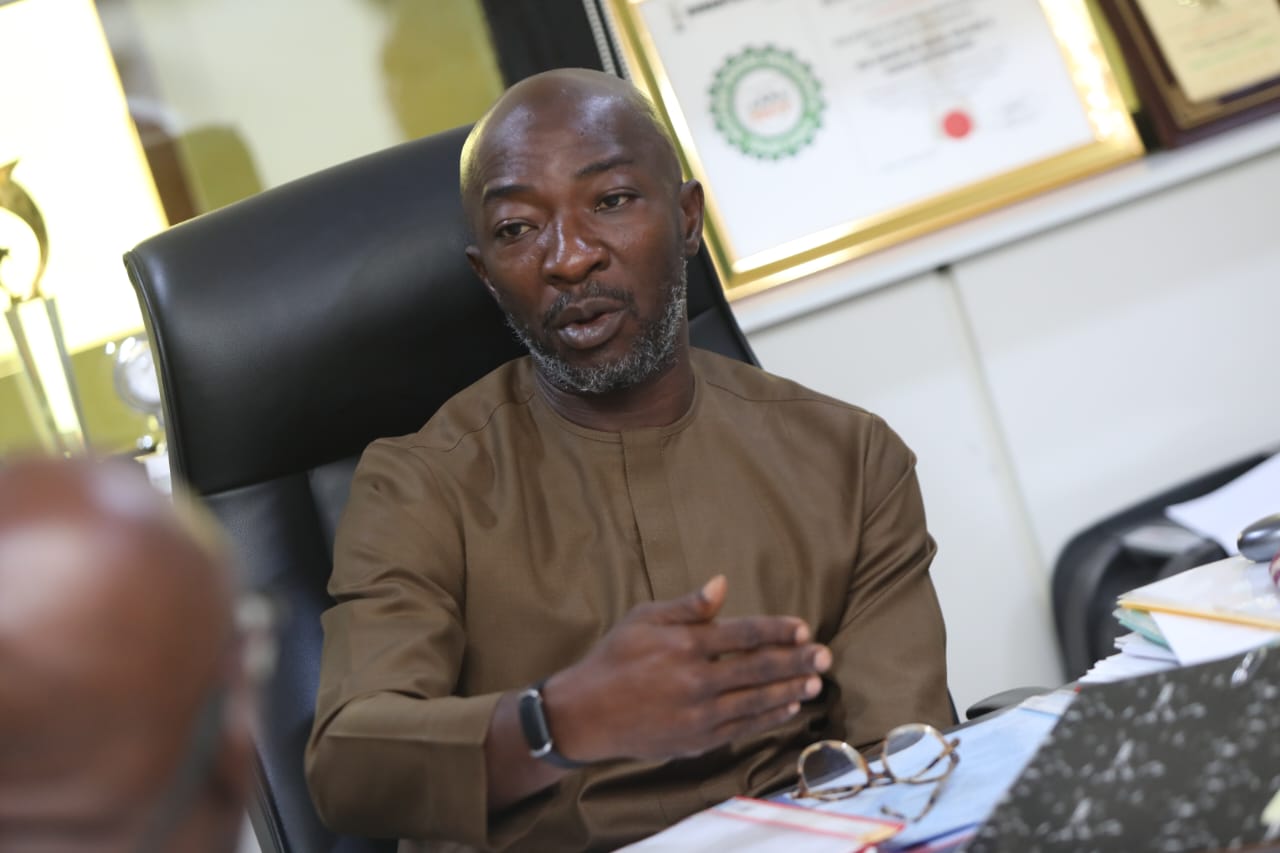
He cuts the picture of a man in a hurry to leave legacies. Leading an organization that has simply been maligned and enmeshed in unnecessary controversies is not easy. Public perception matters and in the years preceding his appointment, very few really cared about the way Nigeria Social Insurance Trust Fund was perceived. Yet, the Fund’s performance and acceptance hinged, more than anything on this perception.
It was therefore not out of place that Barrister Oluwaseun Faleye set out to change this perception completely and rebrand the NSITF. In his first few years in office. He has done just that.
First was to change the public perception, second was to ensure that the changes were not just a facade but genuine and deep-rooted.
Rather than stories of bickering, and sleaze that had dominated the news about NSITF, stories changed. Workers both in public and private sectors read about subscribers to the Fund getting compensation they saw pictures of people who were wounded during official engagements receiving claims because they were insured.
Words have been spreading. A new czar is at NSITF. He has managed to win the workers to his side. He also managed to uproot dead woods in the Fund’s system, according to our findings, his upsetting the applecart has not gone without resistance. When we cornered him for this interview, he didn’t sound like a warlord who finally got his enemies under his feet. Rather, he waxed philosophical when asked about the atrocities committed by his predecessors.
Oluwaseun Faleye might not be giant in stature, but he surely carries a fire that has warmed up the whole of NSITF and ignited a larger fire in a once moribund government parastatal.
In this interview, we bring glimpses of his efforts in actualizing the core mandates of NSITF, the challenges he faces and why Nigerians should look out for him. Excerpts:
In your opinion, what prepared you for your present position as the MD of NSITF?
I think my preparation came from my exposure to public service in LAGOS State under Babatunde Raji Fashola as his Principal Private Secretary and my time with the LAGOS State civil service. I think the exposure for eight years helped me to understand the importance of public service to our community and the rules or ground norms of the civil service. Here, we are talking about the selflessness, transparency and integrity and other things that define public service. I think all these have been helpful in my journey to being where we are today.
You came in here at a time when stories of rot at NSITF was all over the place. Can you shed a little light on the rot you met?
I don’t want to dwell on that, no I don’t. This is because even in the midst of all the issues you raised, there were good work being done as regards to what our core mandate is. You know as it is in life, the bad things are more accentuated than the good things. I choose to focus on the good and great people that I met here and how much they’ve supported our transformation agenda and how much they are committed to it. We can only look forward. What happened happened in the past and the only thing we have to do is learn from those things and not to repeat them again. What is important now is how much impact we are making on workers whose welfare we are saddled with advancing.
One thing we have noticed over the years is the lacuna between management and workers in many organizations especially government parastatals. Over the years we have had that recurring fight between heads of organizations and their workers, but here it’s not the same. How did you do this?
Industrial harmony is critical to whatever we want to achieve, so we have to focus on what our employees want and provide the necessary tools that they require to function effectively.
Perhaps they have seen genuine intentions to deal with these things and ensure that they are working in a much more convenient environment. I also think what you have seen is as a result of mutual respect. Everybody is a human being and we are here to do a job irrespective of what your level is in the organization and if we mutually respect each other and acknowledge that the little each one of us does, from the gate man to the Executive Directors to the Managing Director all contribute to making what NSITF is known for, it will be easier to deal with each other and that’s the mentality I have taken. I am sure that’s the mentality that my colleagues have taken and that’s why there’s this level of industrial harmony that has not been witnessed before in the organization. And we intend to keep that, we intend to do more. Another thing that we have done to foster industrial harmony is to look at deep-rooted issues that have been agitating the minds of the staff in the past. We talk about placement, we talk about renumeration to justify what they do. We have systematically tried to address these and we have continued to do so. Perhaps most importantly in the course of doing all these, and which staff have seen is the transparency in our efforts to address these things. We may not get these right hundred percent but they’ve seen a team that is consistently trying to deliver or tackle those issues and as in all things, if you painstakingly tackle an issue, you will surmount it.
Lets speak on the core mandate of the NSITF, how far have you been able to pursue that in the last couple of years?
That’s our major responsibility and we are doing that in various ways, one of this is advocacy. Advocacy is important because we have realized that there’s not enough knowledge of what the ECS is all about even from the most enlightened and knowledgeable. And it’s our duty to propagate that and let people know. We are big on advocacy and that’s why we are keen to speak with stakeholders just to put our information out there. Part of that advocacy is also looking at what we are doing to accelerate our processes to ensure that those that know about us come out with good experiences to share with others. There’s no better advocate for us than people that have known us and benefited from what we do, one way or the other. If we treat them well, they will spread the word. That is what public service should be to people, quick, fast and efficient, they will tell their friends and families. We’ve done a lot of work in terms of streamlining our core processes relating to one, compliance and two, claims. These are the two areas people want to see. You want to register, people want to see that that the process is seamless. We are doing a lot work around sensitization. We are also looking at digitalization in a way that makes it easier for people to engage so that people can comply. When they comply, there are bound to be accidents, there are bound to be issues so the next stage is claiming. Now when they make claims what are we doing? What are we doing to make the process easier and seamless. We’ve done a lot of work to reduce our claims time and process and we are still looking at it to see where there are clogs. Beyond that, we have our internal processes. For instance if you look at our Admin Department which supports all of these external-facing organization, we ensure that the people that are facing the external stakeholders are not hampered by lack of resources and tools. We are also pushing that agenda in a way.
One of those ways is to look at other core responsibilities that relate to health and safety in work places. One of our departments is tackling that, we have encouraged them to think out of the box, by bringing out the best practices, especially how we can educate and talk to employers to ensure that work places are generally safe for employees because that is also part of our mandate.
All of these combined are pushing us ahead. In terms of compliance, we have engaged with public servants in a lot of ways that now, we see Federal Government being compliant. We’ve done a lot of engagements with the Office of Head of Service to ensure that civil servants are covered. We’ve done a lot of coverage for the private sector but that can still improve. We are now going into the sub-national states. We’ve engaged with Lagos State, Taraba State, Rivers State, Delta State. We are looking at how they can participate in the scheme for not only our benefit but for the benefits of their sub-national economies. This is because we believe that building resilience that this sort of social welfare gives also builds resilience in the community. You will agree that if staff and employees know that we do our work when injuries, disabilities occur and death occurs God forbid, there’s some form of support for families and dependants, it gives them confidence. When we speak of developed countries, exposed countries and their social welfare schemes, it’s not rocket science. These are the kind of schemes they have in place; prompt payment of pension, prompt payment of disabilities claims when accidents occur because they will always occur. These are normal societal supportive mechanisms to build some level of resilience in an economy. We will continue to do that and we will get there, it is not going to be overnight because when we get the States much more compliant, we want to see the Local Governments doing same. That definitely calls for a top to bottom and much more cohesive society.
Beyond our work with the public service, we are also doing advocacy with the informal sector. Majority of Nigerian businesses are in the informal sector and of course we believe that if we are able to bring them in, we will further build this resilience that we are talking about. It is easier to call on NNPC, Shell, Mobil to comply because they have all of these organs and departments in place, the main challenge are the small businesses that serve them, which makes almost 70-80% of our economy are also compliant. The work there is engaging with them, finding the right mix of ideas to make it easier for them to comply.
Those are the things we are grappling with, those are the things we think about every day and we plan to achieve either through partnership or through internal efforts. And we are making incremental progress.
What are the Challenges You are facing?
The challenges are in different ways, from compliance perspective, I mentioned the issue of understanding and knowledge about what it is. You find entities, companies that are not aware of the implication of sometimes underreporting their numbers of staff or not complying at all. Those challenges are there continually. The other challenge is the enforcement mechanism that we have. If we believe that this scheme is very important to our economic well being as a people, we have to provide the necessary enforcement mechanism to ensure that we bring majority of our people under the scheme. Luckily we are speaking with the National Assembly about that. We don’t want to burden businesses too much but we also must ensure that people are complying with the law. That’s the other challenge. Beyond our own internal issues which we are dealing with there are no major challenge that we cannot surmount if we put our mind and intellect into it.
Bamidele Ogundana

Shaba Gbenga is a seasoned public relations guru and social media consultant. With over two decades of experience in journalism and media, he started his career with the Ondo State Radiovision Corporation (OSRC) before contributing to notable outlets such as Hope Newspapers, Encomium Magazine, and YES! International Magazine, among others.